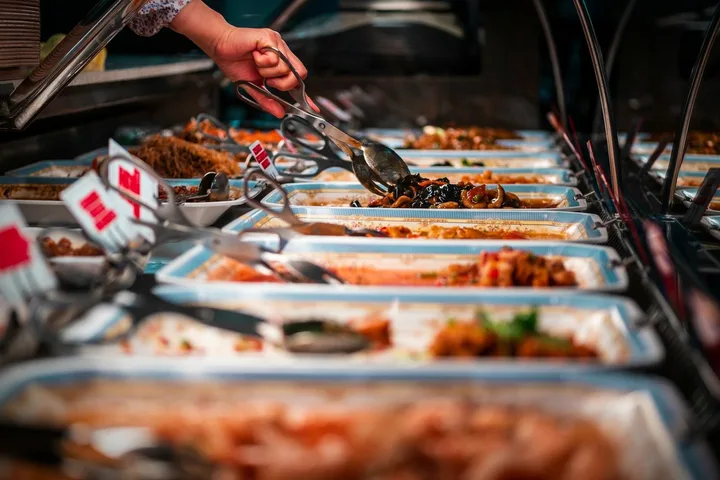
What does buffet mean?
Wikipedia describes a buffet as "a system of serving meals in which food is placed in a public area where the diners serve themselves." For food, Americans usually say it "buh-FAY".
The word first meant a piece of furniture: the French sideboard where food was set out. Over time, the name moved from the sideboard to the meal.
Buffet restaurants usually charge one price for all you can eat. Some charge by weight instead, or by the number of dishes you take.
Where did the buffet come from?
Two traditions shaped the buffet most Americans know.
The first is the Swedish smörgåsbord (SMOR-gus-bord), which literally means "sandwich table". It is often traced to the brännvinsbord, a table of schnapps and small bites that guests visited before dinner. According to Wikipedia, Americans got to know it at the 1939 New York World's Fair, where the Swedish Pavilion's Three Crowns Restaurant served one. In Sweden it's still a celebration meal. Visit Sweden says "The Swedish Christmas table is a smorgasbord of different dishes."
The second is the all-you-can-eat buffet, which is usually traced to Las Vegas. Herb McDonald, a publicist at the El Rancho Vegas hotel, laid out cheese and cold cuts on the bar one night to make himself a sandwich. Hungry gamblers walking past wanted some too. "McDonald inspired the buffet in 1946 more out of hunger than genius, he recalled," says his obituary in the Las Vegas Sun. The paper says the first midnight buffet cost $1.25.
What are the main types of buffet?
- Breakfast buffet. Common in hotels: eggs, bacon, pastries, fruit and cereal, sometimes with a cook making omelets to order.
- Lunch buffet. A weekday deal for people with little time. Many Indian and Chinese restaurants in the US run one.
- Carvery. Staff carve the roast meat, and guests help themselves to the sides. It's common in British pubs and hotels.
- Themed buffet. A taco night, a seafood night or a Sunday brunch, run on a set day.
- Salad bar. Guests build their own salad, often in a deli or supermarket, and pay by weight.
Buffets also turn up at weddings and conferences, where the host pays and nobody sees a price. Our banquet menu guide covers that side.
What's the difference between buffet and à la carte?
On an à la carte menu, each dish has its own price and the kitchen cooks it to order. A buffet flips most of that.
| Buffet | À la carte | |
|---|---|---|
| How guests order | Serve themselves | Order from a server |
| Price | One price per person | A price for each dish |
| Speed | Guests eat right away | Guests wait for each dish |
| Food cost | Hard to predict, since you can't control portions | Easy to predict per plate |
| Waste | Higher, from food left in the pans | Lower |
| Staff | Fewer servers, more cooks refilling the line | More servers |
How do you price a buffet?
With a buffet you can't cost one plate. You cost a whole service. Here's an example method for a weekday lunch buffet.
- For two weeks, add up the cost of all the food you cook for the buffet, including what you throw away.
- Divide by the number of guests. If $480 of food fed 80 guests, that's $6 a head.
- Set the price from there. At $17.95, the food takes about a third of what each guest pays.
Our catering pricing guide builds a buffet quote for an event the same way, adding staff and supplies.
A few habits keep the number steady. Refill small pans more often instead of putting out big ones. Put a cook on the most expensive dish, like carved meat, so the portions stay even. Post the rules near the line, such as the price for kids, whether drinks are extra and any time limit.
How do you label dishes and allergens on the line?
Guests at a buffet can't ask a server about every dish as they go. The label in front of the pan does that job.
Rules differ by country. In the UK, the Food Standards Agency's allergen guidance says "If you offer food in the form of a buffet, you need to provide allergen information for each food item separately." In the US, the FDA's model Food Code asks for written notice of major allergens in unpackaged food, where your state or county has adopted it. Our guide to allergens on menus explains what that means for you.
For each dish, put a card with its name, a short description and its allergens. Label sauces and dressings separately, since guests take them separately. Give each pan its own serving spoon. When a dish changes, change the card too.
Monday to Friday · 11:30 am to 2:30 pm
Salads: garden salad, chickpea and cucumber salad (V, GF)
Hot dishes: butter chicken (contains milk, cashews), chana masala (VG, GF), vegetable biryani (V, contains milk)
Sides: basmati rice, garlic naan (contains wheat, milk)
Dessert: rice pudding with cardamom (contains milk)
A QR code at the start of the line can show the same list on guests' phones. In Menupresso, each dish can carry dietary labels as pills, words or codes with a key. A dish you're not serving today can be switched to Hide from guests. If there's a TV above the line, a free menu board can show the dishes and prices there too.