Dollar signs: what one study found
In 2009, researchers from Cornell University and the Culinary Institute of America tested three menu formats at St. Andrew's, the Culinary Institute's restaurant in Hyde Park, New York. Over lunch, guests got one of three menus:
- prices with a dollar sign, like $14.00
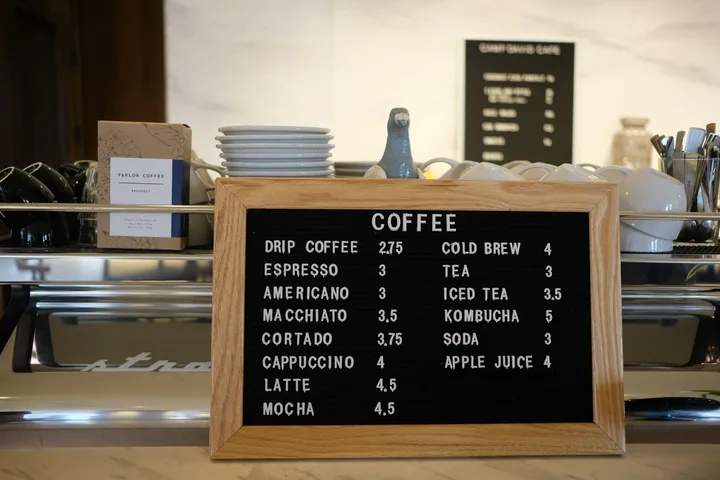
- numbers only, like 14
- prices written out in words, like fourteen dollars
Guests with the numbers-only menu spent more. Cornell's write-up put the difference at an average of $5.55 a check, about 8%. There was no real difference between the dollar-sign menu and the written-out one. The researchers' idea is that the word or symbol for money reminds people that they're paying.
It's one restaurant, at lunch, with about 200 diners. That's a useful hint, not proof that dropping the $ will raise your sales. But there's little downside to trying it. Guests know they're looking at prices.
Cents and whole numbers
Whole numbers are easier to read. "14" is quicker to take in than "14.00," and a menu full of ".00" looks cluttered.
If some of your prices have cents, like 12.50, you have two options:
- Show cents only where they exist: 12.50, 14, 9.50.
- Show cents on every price: 12.50, 14.00, 9.50.
Both work. What matters is picking one style and using it on every menu, board and sign.
Price endings: .99, .95 or round
Prices ending in .99 are common in shops, where they make something look like a bargain. On a restaurant menu they can make the place feel like a discount store.
There's also research on round prices. In a 2015 paper in the Journal of Consumer Research, Monica Wadhwa and Kuangjie Zhang found that round prices suit purchases people make on feeling, like a vacation. Precise prices suit practical purchases, like a household appliance. Their studies didn't involve food or restaurants, so treat this carefully. A dinner out is closer to the vacation end. A quick weekday lunch may be closer to the practical end.
A simple approach:
- Sit-down dinner or a special night out: round prices, like 24 or 32.
- Café, counter or quick lunch: round or half prices, like 4.50 or 9.50, which are also easier when people pay with cash.
- Anywhere: skip .99 unless low price is your main selling point.
Where the price sits
Some menus line prices up in a column on the right, often with a dotted line from the dish. Others put the price straight after the description.
Some menu consultants argue against the column. Restaurant consultant Aaron Allen writes that a column makes guests "scan for the lowest price instead of the most interesting item." He recommends putting the price at the end of the description, in the same size type. We couldn't find a study that tested this, so it's expert opinion rather than a proven effect.
Whichever you choose, keep the price close to the dish name, and don't make guests hunt for it. On a phone, a price that sits on the same line as the dish name is easy to find. Hiding prices or making them tiny tends to annoy guests more than it helps you.
Sizes, extras and changing prices
Some prices need more than one number:
- Sizes: put the size beside each price, like "Small 4.50 · Large 5.50." If every drink comes in the same sizes, a header row with the sizes keeps things tidy.
- Extras: write the extra cost with a plus, like "Add bacon +2." Guests shouldn't learn about extra charges at the till.
- Prices that change daily: for fish or seafood that changes with the market, some restaurants write "market price". Tell guests where to find today's price, such as on the board or by asking staff.
Follow what your guests expect
Not every country writes prices the same way. In much of Europe, prices are written with a comma and the symbol after the number, like 12,50 €. In the US and UK the symbol comes first, like $12.50 or £12.50. Use the format your guests are used to.
Check your local rules too. In some places the law says what a menu price must include, such as sales tax or a service charge.
If you build your menu with Menupresso, you choose the currency for each menu. The price format follows how prices are usually written in that currency, or you can choose the symbol before the price, after it or not at all. You can also pick a dot or a comma and decide whether whole prices show ".00". A dish can have several prices with a label for each, like Small and Large, or a short text instead of a number, like "Market price." There are several price styles too, including a dotted line from the dish name to the price.
Sources
- Yang, Kimes and Sessarego (2009), “$ or Dollars: Effects of Menu-price Formats on Restaurant Checks”, Cornell Center for Hospitality Research
- Cornell Chronicle, “Diners spend more when menus don’t use dollar signs” (2009)
- EurekAlert!, on Wadhwa and Zhang (2015), Journal of Consumer Research
- Aaron Allen & Associates, “Menu design: nested pricing”