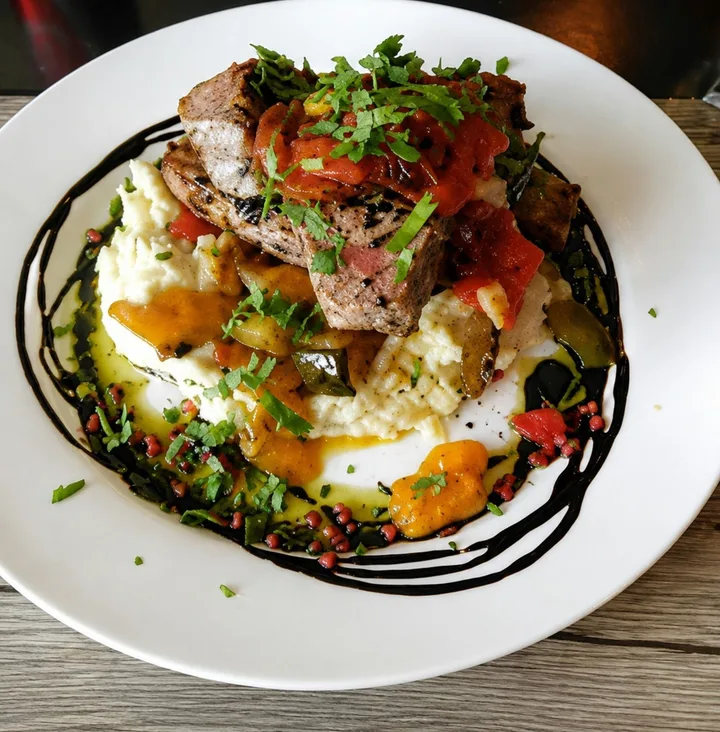
What does blue-plate special mean?
A good early definition comes from a 1929 glossary of lunch-counter slang in the trade magazine The Restaurant Man. Word historian Michael Quinion quotes it on World Wide Words: "A 'blue plate' is the label given a special daily combination of meat or fish, potatoes and vegetables, sold at a special price".
That still describes it well. A typical blue plate is meat or fish with two or three sides, priced below the regular dishes, and different each day. You'll see it written with and without the hyphen: blue-plate special or blue plate special.
"No substitutions" was a common rule. The special was cooked ahead and kept warm, which is what made it fast and cheap. Swapping the potatoes for a salad undoes that.
Where did the name come from?
Nobody knows for sure, so be careful with any story that sounds too neat. Here's what the evidence supports.
The plate itself is the likeliest answer. Quinion cites the Random House dictionary, which defines a blue plate as "a plate, often decorated with a blue willow pattern, divided by ridges into sections for holding apart several kinds of food". On this account, a cheap divided plate held the whole meal, with the meat, potatoes and vegetables kept apart.
The earliest records are from the 1910s and 1920s. Restaurant historian Jan Whitaker writes on her blog, Restaurant-ing Through History, that the first reference she found is from 1915. That year, the Seaboard Air Line Railway announced a daily special of meat or fish with two vegetables, served on one plate. Quinion notes that it appears in The New York Times by 1926. Whitaker sums up the peak: "During the 1920s and 1930s the blue plate lunch and dinner thrived."
Two popular stories are unproven. One says the Fred Harvey railroad restaurants used the term on an 1892 menu. Quinion repeats it but says he couldn't confirm it. Another, quoted on Wikipedia, says Depression-era divided plates only came in blue. Treat both as stories.
Whitaker also explains why restaurants liked the special. Before it, a full restaurant meal, like a table d'hôte dinner, often came on many plates and side dishes. One plate meant less washing up and faster service. She adds that "Blue plate specials were attractive to restaurants because they permitted them to make use of a good buy or get rid of food stocks on the verge of going bad."
What's on a blue-plate special today?
The name has faded. Wikipedia calls it "a vanishing tradition", and in everyday speech it can mean any cheap, full meal. But the format is alive in diners, cafés and lunch counters, often under a plainer name like "daily special" or "lunch special".
The dishes are usually American comfort food that holds well on a steam table:
- meatloaf with mashed potatoes and gravy
- pot roast with carrots and potatoes
- fried chicken or chicken-fried steak
- roast turkey with stuffing
- fried fish on Friday
Many come with a roll, and some include soup, a drink or a slice of pie.
How do you run one at a diner or café?
- Give each weekday its own dish. Regulars learn that Tuesday means chicken and dumplings, and they come back for it. A set weekly rotation is a simple cycle menu.
- Choose dishes you can cook ahead. Braises, roasts and casseroles hold for hours, so the plate goes out in a minute.
- Use the good buy. If the butcher has a deal on pork shoulder, that's Thursday's special. That was one of the old reasons restaurants ran blue plates.
- Price it below your regular plates. If your hot entrées sell for $16 to $19, a $13 or $14 special feels like a deal. Cost it like any other dish with our pricing guide.
- Say what's included and what isn't. Write "No substitutions" if that's your rule, but say you'll help with allergies where you can.
- Run it until it's gone. "Until sold out" tells guests to come early and keeps waste down.
It's close to the French menu du jour, which means menu of the day. The difference is size: a menu du jour is usually two or three courses at a set price, while a blue plate is one full plate.
What does a weekly blue-plate line-up look like?
Monday to Friday · 11 am until sold out
Each comes with a roll and coffee or iced tea
No substitutions. Please ask us about allergies.
For the rest of the menu around it, see our diner menu example.
With Menupresso, the whole week can live in one section. Switch the other four days to Hide from guests and press Publish changes each morning, so only today's plate shows. When it sells out, hide that one too. The QR code on the table never changes, so it always opens today's special.