Family-style dining: what it means and how to price it.

Family-style means the food comes to the table on large platters, and everyone helps themselves. Nobody gets their own plated main. It's the way many families eat at home. It works well for groups, as long as the menu says how it's priced and how many people each platter feeds.

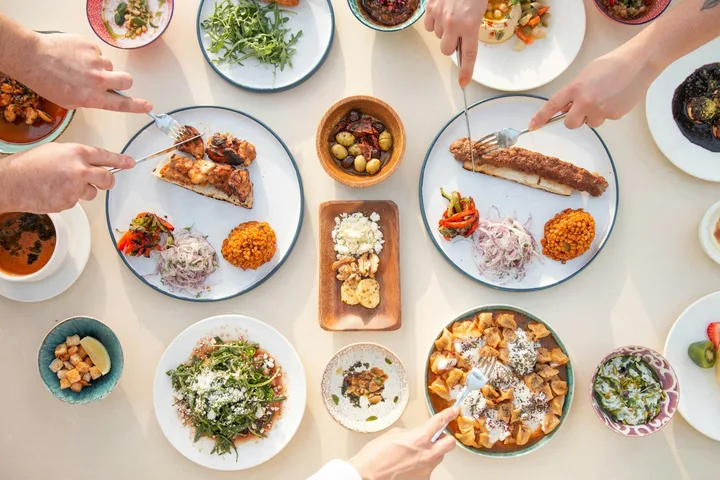
Overhead view of many shared dishes on a table, with diners reaching in with forks
Photo by Ben Koorengevel on Unsplash.

What family-style means

The Cambridge Dictionary describes family-style food as "brought to the table in large dishes so that people can serve themselves."

At a restaurant, you'll usually see it in one of two ways:

  • A group menu. The restaurant serves a set run of shared dishes to a large party for one price per person.
  • Dishes made to share. The regular menu has larger dishes meant for the table, each with its own price.

Both are family-style. The difference is how you price them.

Family-style or small plates?

The two get mixed up, because both involve sharing. The difference is size and timing.

Family-styleSmall plates
Large platters for the whole tableSmall dishes, each a few bites per person
Often served in courses: starters, then mains, then dessertDishes come out when they're ready
Often one price per personEach dish has its own price
Common for groups and celebrationsCommon at tapas, mezze and wine bars

If your menu is small plates, tell guests roughly how many to order. If it's family-style, tell them how many people each platter feeds.

Price per person or per dish?

Per person suits groups. Everyone knows the cost before they arrive, the bill is easy to split, and the kitchen knows in advance what to prep. Navy Beach in Montauk, New York, puts it plainly on its family-style menus page: "our family-style menus are for large groups, booked in advance." When we checked, one of its menus showed "60 per person, does not include tax and service charge", with upgrades priced per person as well.

Per dish suits a regular dinner service, where a table of two might share one platter and a table of six might order four. Here, each dish needs a line saying how many people it feeds, such as "serves 2 to 3." Without it, guests have to guess how much to order.

You can offer both. For example, keep sharing dishes on the regular menu for small tables, and add a set family-style menu for groups of eight or more.

What a family-style group menu can look like

Family-style dinnerExample only

For groups of 8 or more · Book at least 3 days ahead

To start, for the table: warm flatbread and dips, chopped salad

Mains, choose two for the table: roast chicken with lemon, slow-cooked beef, mushroom pasta

Sides: crispy potatoes, green beans

Dessert: chocolate cake, seasonal fruit

Price per person$55
Add grilled prawns$10 per person

Drinks, tax and service charge not included

Every line answers a question the organizer would otherwise have to email you about: minimum group size, notice needed, what's included, what costs extra and what isn't in the price.

Dietary needs in a shared meal

Sharing makes allergies harder to manage. One platter with nuts affects the whole table, and dishes are passed hand to hand.

Piano Piano, an Italian restaurant group in Ontario, Canada, handles this on its group dining page. It says its family-style menu is served "on large platters for guests to share" and "can be easily modified to accommodate vegetarian, vegan, gluten and dairy free dietary restrictions." It then tells guests to contact the location directly.

For your own menu:

  • Ask the organizer about allergies and diets when they book, not on the night.
  • Mark any platter that contains a common allergen.
  • If someone needs a separate plate to be safe, serve it separately rather than putting it on the shared table.
  • Only promise what your kitchen can do. Check every allergen line with the kitchen before you publish it.

Check that the price works

A family-style price has to cover generous platters, because a table that runs out of food feels short-changed. Cost it out on a full table.

Take the $55 example for a group of 10. That's $550. Add up the ingredients for every platter the table will get, using portions large enough that nobody leaves hungry. Use the more expensive main choices, since groups may pick them more often than you expect. Suppose that comes to $165. That leaves $385 for staff, rent, waste, fees and profit. If you refill platters, count the refills too, and say on the menu whether you do.

Our prix fixe guide covers the same check for a set menu with courses.

Put the group menu where organizers can find it

The person booking usually forwards the menu to the rest of the group. A link that opens on any phone works better for that than a PDF attachment.

In Menupresso, you can make the group menu its own section and turn off Individual dish prices. The price per person and the group rules then go in the section introduction. For sharing dishes on the regular menu, keep their prices on and write "serves 2 to 3" in each description. For a mezze-style sharing menu, the Mezze Mosaic template on our menu templates page is one place to start. If you cater as well, our page on menus for caterers covers per-person and per-tray prices for events.

Sources

Share your group menu.

List the platters, the price per person and the booking rules, and send one link to the organizer.

Create a free menuExplore menu templates