What a tasting menu is and how to price one.

A tasting menu is a meal of many small courses, chosen by the chef and sold for one price per person. Guests don't pick dishes. They book, sit down and the kitchen brings each course in order. If you're thinking of offering one, the hard parts are the price and the dietary requests.

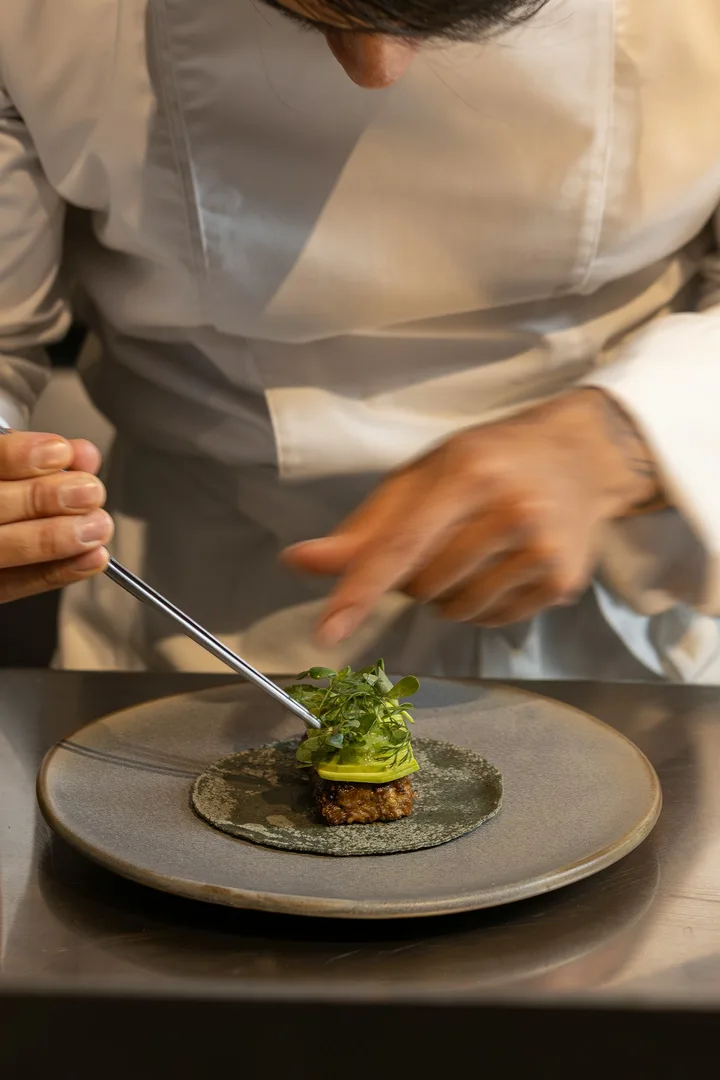
Chef using tweezers to place greens on a small plated course
Photo by Alfonso Betancourt on Unsplash.

What a tasting menu means

The Cambridge Dictionary describes it as a meal "that consists of many different dishes, usually for a fixed price, and often chosen to show the skill of the chef." In French it's a menu dégustation (day-goo-stah-SYOHN), and you'll sometimes see "degustation" on menus in English too.

The portions are small, so a guest can eat many courses without being overfull. There's no standard number of courses. Some restaurants serve five, others serve fifteen or more. A drink pairing, where each course comes with a matching glass, is often offered alongside it.

How it differs from prix fixe

Both are sold at one price per person. The difference is who chooses.

Prix fixeTasting menu
Usually two to four coursesOften five or more
Guests choose a dish at each courseThe chef chooses every course
Regular portion sizesSmall portions
Easy to fit into a normal eveningOften takes two hours or longer

Our prix fixe guide covers the set-price format with choices. If you'd rather price each dish separately, that's à la carte.

What a tasting menu can look like

Here's one way to write a six-course autumn menu:

Autumn tasting menuExample only

Thursday to Saturday, from 6 pm

1 · Warm bread, cultured butter

2 · Beet tartare, horseradish, rye crumb

3 · Squash soup, toasted seeds

4 · Cod, mussels, leeks, cider sauce

5 · Duck breast, red cabbage, blackberries

6 · Apple tart, brown butter ice cream

Price per person$85
Wine pairing$45
Non-alcoholic pairing$30

About 2½ hours · Served to the whole table

The last lines cover the practical questions: what it costs, what drinks cost on top, how long it takes and whether everyone at the table has to order it.

Allergies and dietary requests

Guests can't pick around a course they can't eat, so dietary needs take more planning than on a regular menu. Decide your answers before you open bookings.

  • Ask at booking, not at the table. The kitchen may need a day or more to swap a course. Tell guests how much notice you need.
  • Say what you can change. For example: "We can make this menu vegetarian with 48 hours' notice." If there's something you can't do, such as a fully gluten-free menu, say that too.
  • Brief the team. Servers should know which courses contain common allergens, and the kitchen should get each table's requests before service starts.
  • Check before you publish. Confirm every allergen line with the kitchen. A menu shouldn't promise more than the kitchen can safely do.

Pricing and pairings

A tasting menu costs more to run than its ingredient list suggests. Every course is a separate plate to cook, check and carry, and the kitchen preps for many more dishes per guest.

Take the $85 example. Suppose the ingredients for all six courses come to $26. That leaves $59 per guest for staff, rent, waste, card fees and profit. Then look at prep time. If a course takes far longer than the rest, it may cost you more than its ingredients show. Our prix fixe guide has a fuller example of checking a set price.

For drink pairings, show the price per person and keep a non-alcoholic option on the same line. Guests who don't drink shouldn't have to ask whether one exists.

When a tasting menu works, and when it doesn't

It suits a kitchen that changes its menu often and wants to cook its best dishes every night. Prep is predictable, because you know what every guest will eat. It works well for special evenings, chef's counters and small rooms with a fixed number of seats.

It's a harder sell for regulars who want a quick dinner. Some chefs have moved away from it. In 2025, Edinburgh chef Dean Banks replaced the tasting menus at his Pompadour restaurant with à la carte. He told Restaurant Online: "Consumers are moving away from multi-course tasting menus, instead preferring restaurants where they can enjoy premium dishes at an accessible price point."

You don't have to choose one or the other. Some restaurants offer a shorter tasting menu next to an à la carte menu, or keep the tasting menu for weekends only.

Write it for the guest

Give each course a short line with the main ingredients, in the order it's served. Put the price per person, the pairing prices, the nights it runs and how long it takes in one place, close to the top.

In Menupresso, you can put the courses in one section and turn off Individual dish prices for that section. The price per person then goes in the section introduction, so the menu shows one price, not six. If you also use the free reservations calendar, the booking form has a Special requests field where guests can list allergies when they book.

Sources

Publish your tasting menu.

List each course in order with one price per person, and update the menu when the season changes.

Create a free menuExplore menu templates