What does teishoku mean?
Teishoku (tay-SHOH-koo, 定食) means "set meal". Japan's national tourism site puts it simply: "Teishoku is a set meal where all of the courses are served together." You'll find it at shokudō, Japan's casual diners, at specialist set-meal restaurants and at many lunch counters.
It isn't only breakfast, even if photos of Japanese breakfast trays look similar. A Resy article on Ootoya, a set-meal chain founded in Tokyo in 1958, makes the point: "Outside of Japan, teishoku, the set meal, is often misunderstood as synonymous with the Japanese breakfast."
The pattern behind it is often described as ichijū sansai, "one soup, three sides". The Japanese government's Highlighting Japan magazine defines it as "a meal consisting of rice as the staple food, main dish such as seafood, meat, and other animal products, side dishes such as vegetables, potatoes, and beans, alongside soup and pickles." The idea goes back to older formal meals, including kaiseki. A teishoku doesn't always have exactly three sides, but it follows the same balance.
What comes on a teishoku tray?
A typical tray has:
- Rice, usually white, in its own bowl.
- Miso soup, in a lidded or open bowl.
- The main dish: fish, pork, chicken, beef or tofu, often with shredded cabbage or other vegetables.
- Pickles, called tsukemono. The tourism site calls them "a staple of teishoku set meals."
- One or two small sides, such as spinach with sesame, simmered vegetables, cold tofu or a little salad.
Where each bowl sits matters to guests who know the food. Wikipedia describes the traditional setting: "place a bowl of rice on the diner's left and to place a bowl of miso soup on the diner's right side." The main and sides go behind them.
Some set-meal restaurants in Japan even offer free rice refills. SoraNews24 visited one chain where a rice robot does the refilling.
Common teishoku
Most teishoku menus are built from a handful of classics:
- Karaage teishoku: Japanese fried chicken, marinated, coated in starch and fried.
- Saba shioyaki teishoku: salt-grilled mackerel, often with grated daikon.
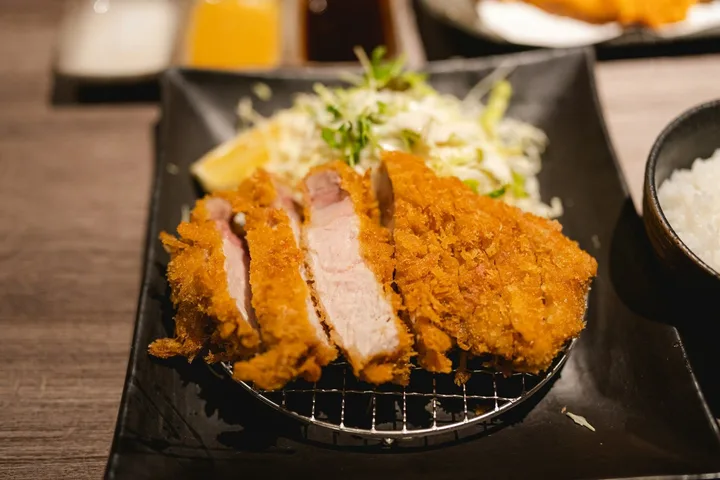
- Tonkatsu teishoku: a breaded, fried pork cutlet with shredded cabbage and a thick, sweet-savory sauce.
- Shōgayaki teishoku: ginger pork, thin slices cooked with ginger and soy sauce.
You'll also see grilled salmon, hamburger steak, sashimi and tempura sets. Many shops add a higawari teishoku, a set that changes daily.
Teishoku vs bento vs donburi
All three are Japanese meals built on rice, so guests mix them up. Here's how they differ:
| Teishoku | Bento | Donburi | |
|---|---|---|---|
| What it is | A set meal on a tray | A single-portion boxed meal | A bowl of rice with a topping |
| Rice | In its own bowl | In one part of the box | Under the topping |
| Soup | Miso soup on the side | Usually none | Sometimes on the side |
| Where it's eaten | At the table, served hot | Take-out or packed from home | At the table or counter, served hot |
| Example | Grilled mackerel set | Salmon and rice lunch box | Katsudon, pork cutlet and egg on rice |
Wikipedia defines a bento as "a single-portion take-out or home-packed meal". A donburi is the main exception to the custom of keeping other food off the rice.
How a café or lunch spot can offer set meals
Teishoku suits a small kitchen because most of the tray is the same for every order. Only the main changes.
- Keep the list short. Three to five sets that share the same rice, soup, pickles and side are easy to prep and quick to serve.
- Say once what every set includes. Put All sets come with rice, miso soup, pickles and a small side at the top of the section, then list only the mains.
- Give each set one price. Put extras like a large rice or an added egg in their own short list.
- Add a daily set. A cheaper daily special uses up what you have and gives regulars something new.
- Be clear about the soup. Miso soup is usually made with dashi, a stock that often contains fish. If you offer a tofu set for vegetarians, say whether the soup is fish-free.
For a sample menu with Japanese names and English descriptions, see our izakaya menu example. India's thali works on a similar idea: many small dishes, one plate, one price.
Sources
- Japan National Tourism Organization, “Dining Out in Japan”
- Highlighting Japan (Government of Japan), “Preserving Washoku for Future Generations” (2023)
- Resy, “These New York Restaurants Embrace the Art of Japanese Home Cooking” (2026)
- Wikipedia, “Japanese cuisine”
- Wikipedia, “Bento”
- Wikipedia, “Donburi”
- Wikipedia, “Karaage”
- SoraNews24, “Rice robot serves free refills at Japanese set meal restaurant” (2023)