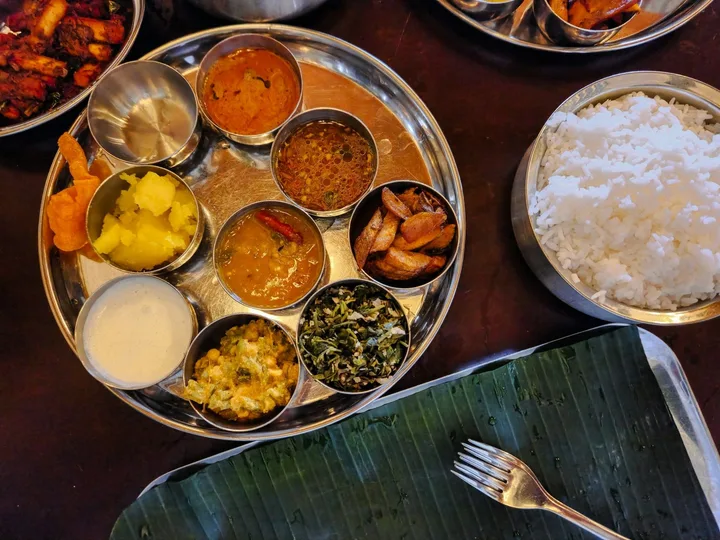
What does thali mean?
Thali (TAH-lee) is Hindi for "plate". Wikipedia explains that the word "is also used to refer to an Indian-style meal made up of a selection of various dishes which are served on a platter." The small bowls around the edge are called katoris. Traditional thalis were made of kansa, a copper and tin alloy. Most restaurants today use steel, and some use a tray with built-in sections.
In South India, the same kind of meal is often called meals, or bhojanam in Telugu, which means "full meal". There, rice is the staple rather than bread.
What's usually on a thali?
The mix changes from place to place, but most thalis include:
- Rice or bread, or both. Roti, puri or another flatbread, with rice in the center or served after the bread.
- Dal, a lentil dish.
- One to three vegetable dishes, often called sabzi or shaak.
- Yogurt, as plain dahi, raita or kadhi, a yogurt and gram flour curry.
- Pickle and chutney, in small amounts.
- Papad, a thin crisp wafer.
- A sweet, such as kheer, halwa or gulab jamun.
The idea is balance. Wikipedia notes that thali presentation often covers the six tastes of Ayurvedic tradition: sweet, salty, sour, pungent, bitter and astringent.
Regional thalis
India has dozens of regional thalis. Here are four you'll often see on menus. The first three are described on India's official tourism site, Incredible India:
- Gujarati thali. Usually vegetarian, with dal and some vegetables lightly sweetened. The Ahmedabad guide lists "different breads (like phulka, bhakri, puri) crafted from diverse flours, rice varieties, buttermilk, farsan," with farsan meaning savory snacks like dhokla and kachori.
- Rajasthani thali. Dishes like dal baati churma (lentils, baked wheat rolls and a sweet crumble), gatte ki sabzi (gram flour dumplings in a yogurt gravy) and ker sangri, dried desert berries and beans, with millet roti, according to the Jaisalmer guide.
- Punjabi thali. Often dal makhani, lentils slow-cooked with butter and cream, with flatbreads and a glass of lassi. In winter, sarson da saag with makki di roti, mustard greens with cornbread, is a classic, as the Chandigarh guide describes.
- South Indian meals. Rice with sambar, rasam, vegetable dishes, curd, appalam (papad) and payasam, a sweet. It's often served on a banana leaf. Wikipedia notes that before a traditional meal, people clean a banana leaf "which is used as a large sheet for serving food."
Kerala's sadya is a banana leaf meal too, but it's a vegetarian feast for weddings and festivals like Onam rather than an everyday plate, as Kerala Tourism explains.
Thali vs other set meals
A thali is a set meal, but it isn't served like the set meals most American guests know.
| Thali | Table d'hôte | Teishoku | |
|---|---|---|---|
| From | India and South Asia | France | Japan |
| How it arrives | All at once, on one plate | Course by course | All at once, on a tray |
| Choice | Usually none, or veg or non-veg | A choice within each course | Choose the main |
| Refills | Some restaurants refill bowls | No | Some offer more rice |
Our guides to table d'hôte and teishoku cover the other two.
Unlimited, veg and non-veg thalis
Some restaurants serve an unlimited thali. Servers walk the room with pots and refill the bowls until the guest says stop. At Shree Thaker Bhojanalay in Mumbai, The Infatuation describes servers who "walk around and fill (and refill) steel plates and bowls, while urging diners to go for third helpings." The restaurant has served a Gujarati thali since 1945, according to Wikipedia.
If you offer refills, say exactly what's included. A line like Refills of dal, vegetables, rice and roti; one sweet per guest stops awkward moments at the table. Cost it on a hungry guest, not an average one.
Wikipedia also notes that "Restaurants typically offer a choice of vegetarian or meat-based thalis." A non-veg thali usually swaps one or two bowls for a chicken, mutton or fish curry. Keep them as separate items with separate prices. If your vegetarian thali uses ghee, paneer or yogurt, it isn't vegan, so say so for guests who ask.
Sources
- Wikipedia, “Thali”
- Incredible India, “Food Guide: The Best Gujarati Thalis in Ahmedabad”
- Incredible India, “Discover Jaisalmer's culinary kaleidoscope”
- Incredible India, “A gastronomic journey through must-try local” (Chandigarh)
- Wikipedia, “Gujarati cuisine”
- Wikipedia, “Tamil cuisine”
- Kerala Tourism, “What is Kerala Sadya?”
- The Infatuation, “Shree Thaker Bhojanalay” (Mumbai)
- Wikipedia, “Shree Thaker Bhojanalay”